French Guiana
Culture Name
French Guianese
Alternative Names
Guyane Francaise
Orientation
Identification. Christopher Columbus sighted the Guiana coast in 1498 during his third trip to the New World. The French first settled the land one hundred years later, calling it Guiana, the French form of an American Indian word that means "land of waters."
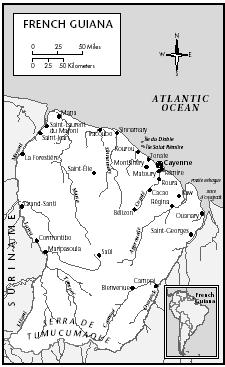
Location and Geography. French Guiana is on the northern coast of South America. It is nestled between Suriname to the west and Brazil to the east and south. It covers approximately 34,750 square miles (90,000 square kilometers), about the same size as Indiana. The close proximity of the equator (which lies a few degrees south) contributes to the hot and humid climate, which averages 80 degrees Fahrenheit (27 degrees Celsius) all year.
There are three main regions: the coastal plain in the north, a hilly plateau in the middle, and the Tumac-Humac Mountains in the south. Most of the interior (83 percent of it) is dense tropical rain forest. There are more than twenty rivers that flow into the Atlantic Ocean from French Guiana. The most important of these are the Oyapock, which forms the southeastern border with Brazil, and the Maroni, which forms the border with Suriname.
Demography. The 1998 population in French Guiana was approximately 167,982. Around 40 percent of the population lives in the capital of Cayenne. African and Afro-Europeans make up 66 percent of the total population with Europeans making up another 18 percent and east Asians, Chinese, Amerindians, and Brazilians making up the remainder. In the sparsely populated interior the Oyampi and Palik tribes still follow a traditional pre-columbian way of life. There are also a few tribes descended from African slaves who escaped from plantations to live a lifestyle similar to their native central Africa.
Linguistic Affiliation. The official language is French. All business and most common dialogue is conducted using the mainstream French. The native tribes in the interior, however, use their own language, and the African tribes use Taki-Taki, a pidgin English.
Symbolism. The heavy influence of the French culture is evident throughout the country, and in the capital many of the customs and attitudes of France predominate.
History and Ethnic Relations
Emergence of the Nation. The Arawak Indians are the people first known to inhabit French Guiana. The next major waves of people were the Caribs. These peoples came from the Amazon and traveled to the Antilles (most of the islands of the West Indies). The Caribs displaced many of the Arawak. During the age of discovery and Christopher Columbus's journeys, the Caribs were still traveling through the Caribbean.
The French were the first Europeans to settle in French Guiana. They arrived in the early 1600s, when many of the European powers were colonizing the Americas and looking for the lost city of gold, El Dorado. Between the climate and Indian attacks the first settlement was a failure. In 1634 the French settled again and this time they did not leave. Cayenne was founded as the capital some time later and it has remained the country's largest city.
Plantations were established in parts of the land, forming an economic base. Following a series
Twenty years later Kourou was once again in the spotlight of France and receiving its people. This time, however, scientists—not prisoners—were arriving, to construct and operate the European Space Agency's rocket-launching center.
In 1946 French Guiana ceased being a colony and became an official overseas department of France. The 1980s saw the rise of a pro-independence party, but ultimately the group lost power because the majority of French Guianese support being a part of France.
National Identity. In the political and cultural sense there is no national identity. The nation for the French Guianese is France. The diversity of ethnic groups and the lack of common history add to the problem of internal national identity. The Amerindians living in the central part of the country seem to identify the least with the French and European way of life.
Ethnic Relations. A complex weave of ethnicity and culture forms French Guiana's population. The Creole population, itself a large mix of ethnicity and culture, comprises the largest ethnic group and has had the greatest influence on the country's culture. Fewer than one hundred of the native settlers, the Arawaks, currently live in the central part of the country. The Caribs have a few small communities along the coast and have mingled with the Creoles. There is also a noticeable settlement of Vietnamese who came over in the early and middle parts of the twentieth century. The cultures interact fairly well and inherently adopt and adapt to local flavors. Considering the small population, the larger culture is forced to recognize all of its peoples.
Urbanism, Architecture, and the Use of Space
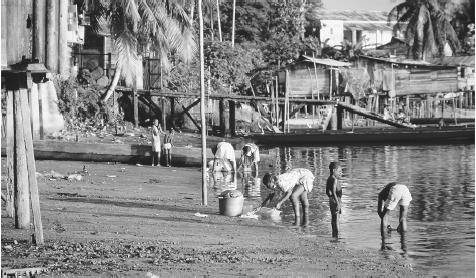
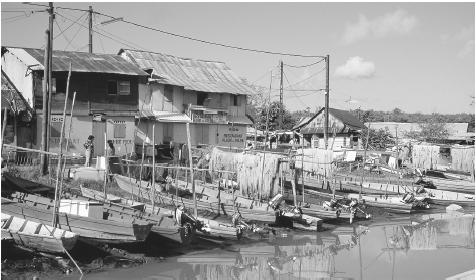
With the exception of the Amerindian tribes in the interior, most people live in one of the cities. Cayenne alone has 40 percent of the population. Houses range greatly in size and uniqueness, but the relative prosperity that results from living under the French flag allows the houses to be built of decent quality, and almost all have running water and electricity. They are usually painted light colors such as blue and yellow in keeping with the Caribbean Creole style. Small gardens are often annexed to the houses. The Amerindian residences in the interior are usually simple thatched roof huts, following tradition.
Food and Economy
Food in Daily Life. The diversity of cultures has given the local foods their flavor. Caribbean and Creole style foods are common along with Western foods and such Asian cuisines as Vietnamese and Chinese. Seafood, especially shrimp, is eaten quite often. Rice accompanies most of the dishes.
Basic Economy. The economy is closely tied to France. Shrimp and other seafood production is the
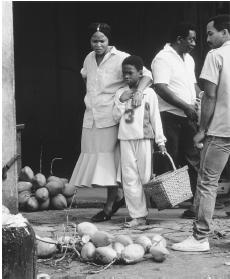
Commercial Activities. Family members still comprise the farm labor. Locally grown vegetables and fruit are sold in markets along with fish and meats. The demand for livestock is heavy and likewise can be profitable for the sellers. Small craft-work is sold to both tourists and locals. The building materials for these crafts and for carpentry projects are also sold. Among the major buyers of these materials are the many small-scale construction companies. The service sector is also important at the local level.
Major Industries. The major industries are shrimp and fish processing and aerospace. Lumber and construction are secondary industries. The agricultural products are sugar, rice, manioc, cocoa, vegetables, and bananas. Cattle, pigs, and poultry are the main livestock animals.
Trade. The major exports are shrimp, lumber, gold, rice, rum, rosewood essence, and clothing. In 1997 the exports totaled $148 million (U.S.). France bought the bulk of the products, more than 60 percent, with the United States, the European Union, and Japan buying the rest. French Guiana has always bought much more then it sold, resulting in high trade deficits since its inception. In 1997 the country imported $600 million (U.S) of goods, such as processed meats, grains, machinery, fuels, and chemicals. The largest import partner is of course France, with Germany, Belgium, and the United States making up the remainder. A large national debt has accrued because of the constant trade deficit.
Division of Labor. The total labor force in 1997 was 58,800. The bulk of the labor force (60 percent) fell within the service, government, and commerce sectors. Industry accounted for 21 percent and agriculture 18 percent. Unemployment was at nearly a quarter of the total labor force and affected mostly younger workers.
The fishing and forestry sectors rely on local, many times unskilled, labor. The space center in Kourou employs some of the most educated persons in the world. In addition to scientists, the space center employs numerous lower-skilled workers to pave roads, construct buildings, transport goods, and perform service functions ranging from food production to hotel management.
Social Stratification
Classes and Castes. The heavy subsidization by the French government has resulted in much more disposable income than if the country would have to rely on its own products alone. This helped create the highest standard of living in South America. The rural parts of the country see the least of the relative prosperity.
Symbols of Social Stratification. The common indicators of wealth in the Western world are also relevant in French Guiana. These include French-fashioned clothes, larger houses, and education.
Political Life
Government. French Guiana is a part of the French Republic and thereby subject to the same regulations and political hierarchy as France. There is a general council that handles local affairs and the relationship with the republic. It is composed of sixteen elected officials from each canton. They elect a president of the department.
Regional councilors are elected by proportional representation of the political parties. This council involves many of the same tasks as the general council but focuses more on long-term economic issues. A prefect, appointed from Paris, technically has the most power in the department but is usually relegated to military and security duties as the local officials are given more say in the running of the country. Two deputies and one senator are sent from French Guiana to Paris to serve in the national parliament. The judicial branch is the same as mainland France with the highest local court based on the Caribbean island of Martinique.
Leadership and Political Officials. The leader credited with exerting the most influence in regard to French Guiana becoming an overseas department is Gaston Monnerville. He was the elected deputy in the years 1932–1946—the last year of his service being the year that departmentalization was enacted. Another important political figure of the time was the mayor of Cayenne, Constant Chlore. He was the founder of the only communist party in French Guiana and became integral to trade union pacts. Since that time French Guiana has had a rotating cast of local politicians in favor of and against French rule. As of 2001, the locally elected prefect was Dominique Vian.
Social Problems and Control. French Guiana has had no major human rights abuses in recent times.
Military Activity. The defense of borders is a responsibility of France. This military includes the French Forces and the Gendarmerie. The availability of men fit for service was thirty thousand in 1999.
Social Welfare and Change Programs
Local officials are in charge of social planning.
Nongovernmental Organizations and Other Associations
European agencies, trade unions, and other associations with France are prevalent in French Guiana.
Gender Roles and Statuses
Division of Labor by Gender. Women are generally responsible for tending to the children and other household tasks. The men are in charge of providing financial support. This holds especially true in the rural areas, although there is some variation among the different ethnic groups.
The Relative Status of Women and Men.
Business and politics are governed by the French system. There is no systematic discrimination against women, but women tend not to be in the upper echelon of either field.
Marriage, Family, and Kinship
Marriage. Most marriage ceremonies take place within the church, as is the custom in most of South America.
Domestic Unit. Families have followed a Western trend of becoming smaller. The average birthrate is 3.31 children per woman. Regardless of size, families maintain their closeness through activities and religion.
Kin Groups. As with families, the members of larger kin groups tend to be close and live within close proximity to one another.
Socialization
Child Rearing and Education. Schooling is compulsory until age sixteen. Primary schools exist all over the country, while secondary schools are located primarily in Cayenne and large towns. The educational system is the same as in France and has contributed to the literacy rate of more than 80 percent.
Higher Education. Professional and university level students get their education overseas, usually in France. Because of the students' European Community status, they are granted all the same privileges as European students.
Etiquette
French values permeate French Guiana. Dress is Western in style in the sense that light colors and short sleeves are worn in warm climates. The people are generally known for their friendliness, although the indigenous peoples in the interior see very few foreigners and therefore may appear to be wary at first.
Religion
Religious Beliefs. The vast majority of French Guianans are Roman Catholic. There are many other religions practiced by the minority groups. These include indigenous Amerindian shamanistic religions, Buddhism, Hinduism, Islam, and Africanbased religions.
Death and the Afterlife. The Catholic rituals are followed, including a cycle of prayers upon death and a funeral at which friends and family gather.
Medicine and Health Care
All medical affairs are handled by the State Department of Health. This department works with such organizations as the Pasteur Institute to eradicate diseases. Vaccinations are free and compulsory for tuberculosis, diphtheria, polio, yellow fever, and measles, mumps, and rubella. There are high incidences of malaria (almost six thousand cases in 1995), dengue fever, and various sexually transmitted diseases. A number of AIDS cases have ended in death, accounting for approximately 10 percent of all adult deaths.
There are seven medical doctors per ten thousand people, but these doctors are available only in urban areas. The average life expectancy is 76.4 years.
Secular Celebrations
All major French holidays are celebrated, including Bastille Day, Labor Day, and the Catholic holidays.
The Arts and Humanities
Performance Arts. The various ethnic groups value dance and music. The urban areas listen to modern music; the tribes of African origin produce drumbeat-driven rhythms; and the Amerindians focus more on wind instruments such as flutes.
The State of the Physical and Social Sciences
French Guiana has perhaps more diversity then any other country in the world in this regard. The interior population has learned little or nothing of the sciences, while on the coast the European Space Agency leads one of the most sophisticated operations in the world. The future seems to hold more of this great divide.
Bibliography
Burton, Richard, and Fred Reno, ed. French and West Indian: Martinique, Guadeloupe, and French Guiana Today, 1995.
Gall, Tim, ed. Worldmark Encyclopedia of Cultures and Daily Life, 1998.
Rajewski, Brian, ed. Countries of the World, 1998.
U.S. Government, Central Intelligence Agency. CIA World Factbook, 2000.
—D AVID M ATUSKEY
i would recommend it totally..... its very helpful and it gave me soo much information. haha. thanks alot.
Thank You!
you dont even know how much diz helped uz wiv our skwl project.
i've learnt more today than ive ever learnt about anything.
diz iz so informational.
we've really apprieciated dis helpful writing.
it da bomb.
p.s dont worry i gave credits to you on it lol
peace out g!
thanks:)
Can you supply some cost of living information?
Thanks.
Gracie Couch
THANKS!!!