Dinka
PRONUNCIATION: DEEN-kuh
LOCATION: Republic of Sudan
POPULATION: Over 1 million
LANGUAGE: Dinka
RELIGION: Monotheistic worship
1 • INTRODUCTION
The Dinka are one of the largest ethnic groups in the Republic of Sudan. They belong to a group of cultures known as the Nilotic peoples, all of whom live in the southern Sudan.
In 1983, a civil war erupted in the Sudan, pitting the largely Arab and Muslim northern Sudan against the black African peoples of the south. Lasting into the 1990s, the war has had dire consequences for the Dinka and other Nilotic peoples. Tens of thousands of Dinka have died; countless others have become refugees. Rebel groups and international human rights organizations have accused the Sudanese government of attempting genocide against (extermination of) the Dinka.
2 • LOCATION
The Dinka inhabit a vast region in the south of the Sudan that forms a seasonal swampland when the Nile River floods. Due to civil war, large numbers of Dinka have migrated from the southern Sudan to the northern Sudanese capital of Khartoum, as well as to Kenya, Uganda, Europe, and the United States.
3 • LANGUAGE
Linguists classify Dinka as a major language family in the Nilotic category of African languages. The Dinka have a diverse vocabulary with which to describe their world. It is estimated that they have more than 400 to refer to cattle alone—their movements, their diseases, and their variety in color and form.
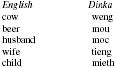
| English | Dinka |
| cow | weng |
| beer | mou |
| husband | moc |
| wife | tieng |
| child | mieth |
4 • FOLKLORE
The Dinka tradition of oral literature is extensive and a considerable amount has been recorded. Two figures stand out prominently, Col Muong and Awiel Longar. Col Muong has an enormous appetite for all things in life. When he is hungry, he is said to eat an entire herd of cattle or an entire field of grain. Stories about him suggest that people should do the best they can with what they have. Awiel Longar figures as the common ancestor of all Dinka peoples.
5 • RELIGION
Dinka religion may be regarded as monotheistic (believing in one deity). Nhialic (creator) is thought to be the source of all life and death. Lesser manifestations of the creator's power are honored by the Dinka through ritual sacrifices. Rituals are performed at births, deaths, to cure disease, and in times of crisis.
6 • MAJOR HOLIDAYS
Celebrations take place in the autumn when the whole tribe is together. To honor their traditional spiritual and political leaders, the Dinka enacted day-long ceremonies marked by large public gatherings and the sacrifice of many cattle.
7 • RITES OF PASSAGE
Birth, marriage, and death are all marked by standardized customs involving public ceremonies. These are typically accompanied by animal sacrifice. In the passage to adult status, young men, rather more than young women, are publicly recognized. Adult males decorate initiates' heads with a series of deep gashes that form permanent scars.
8 • RELATIONSHIPS
When men become adults, they no longer refer to themselves by their birth names. Instead they adopt "ox-names"—derived from characteristics of their favorite cattle. Thus, a man may be known as Acinbaai (a man who never leaves his herd of cattle). Children's names often reflect the circumstances of their birth.
9 • LIVING CONDITIONS
Traditionally, the Dinka dwelled in round clay huts with conical thatched roofs. Homesteads were typically surrounded by a garden and separated from each other by an open expanse of grassland forest. Garden soil would typically maintain its fertility for ten to twelve years. Following this, the area would be set afire and a new homestead erected nearby.
10 • FAMILY LIFE
Polygamy (multiple spouses) is common among the Dinka. Men of high social standing may have as many as fifty to one hundred wives. In polygamous marriages, wives cooperate in performing household duties, although each rears her own children. Much of Dinka public life is dominated by men. However, women play a significant and even powerful role in local life.
11 • CLOTHING
The Dinka wear very little clothing and no shoes. Men go naked, and the women may wear goatskin skirts. Both men and women wear strings of beads around their necks. Women also wear bangles on their arms and legs, and they may also wear elaborate jewelry in their ears.
12 • FOOD
Dinka have traditionally produced all the material resources needed to sustain their livelihood via a combination of horticulture (gardening) with pastoralism (nomadic herding), fishing and occasional hunting. Millet is the mainstay of the Dinka diet. Depending on the season, it is supplemented with cow milk, fish, meat, beans, tomatoes, or rice.
13 • EDUCATION
The Dinka lacked any formal system of education until literacy (reading and writing) was introduced via mission schools in the late 1930s. Even today, most Dinka lack the ability to read and write. The educational system has disappeared due to war.
14 • CULTURAL HERITAGE
Song and dance play an important role in Dinka culture. A set of drums is found in every Dinka settlement. Artistic expression is associated with cattle, which they often imitate in songs and dances. There are also battle songs, songs of initiation, and songs celebrating the tribe's ancestors.
Following is a typical Dinka song:
O Creator
Creator who created me in my mother's womb
Do not confront me with a bad thing
Show me the place of cattle,
So that I may grow my crops
And keep my herd.
15 • EMPLOYMENT
Tending herds of cattle and growing millet form the basis of the livelihood and economy of the Dinka. Labor is clearly divided along gender lines, with men in their twenties and thirties devoting their time to cattle-herding. Women are responsible for growing crops, although men clear new fields for planting. Women also cook and draw water.
16 • SPORTS
Dinka men engage in mock sparring, using spears or sticks and shields, in order to develop their fighting skills.
17 • RECREATION
There is little time for recreation during the dry season, when much of the Dinka population disperses to follow the herds. Song and dance accompany social events such as marriages, which take place during the rainy season.
18 • CRAFTS AND HOBBIES
Dinka men make spears and fishing hooks. Women make clay cooking pots using a coiling technique. Besides making pots, which are essential for carrying water, Dinka women also weave baskets and sleeping mats.
19 • SOCIAL PROBLEMS
Since the civil war that began in the 1980s, numerous Dinka villages have been destroyed by burning or bombing. Thousands of Dinka women have been raped and their husbands castrated in their presence. Many Dinka have been abducted and sold as slaves in the northern Sudan. Violence against the Dinka is now on a level that has no precedent in their remembered past.
20 • BIBLIOGRAPHY
Burton, John W. "Dinka." Encyclopedia of World Cultures. Boston: G. K. Hall, 1992.
Deng, Francis Mading. Dinka Cosmology. London, England: Ithaca Press, 1980.
Deng, Francis Mading. Dinka Folktales: African Stories from Sudan . New York: Africana Publishing, 1974.
Deng, Francis Mading. The Dinka and Their Songs. London, England: Oxford University Press, 1973.
Lienhardt, R. G. Divinity and Experience: The Religion of the Dinks. Oxford, England: Clarendon Press, 1961.
Ryle, John. Warriors of the White Nile. Amsterdam, The Netherlands: Time-Life Books, 1982.
WEBSITES
ArabNet. [Online] Available http://www.arab.net/sudan/sudan_contents.html , 1998.
World Travel Guide. Sudan. [Online] Available http://www.wtgonline.com/country/sd/gen.html , 1998.
-Two Thumbs Up.
there history
tradtoins
way of life
i have a lot 2 write and this got me started, it really helped thx
Culture .
i really love it.
-4 stars
But my heart is just torn apart when I hear of the fighting, the massacres and the destruction of villages. I am baffled as to how a such conflict could have leaked from leadership cults to drench the grass roots communities. The Dinka and Nuer have the same life style, economy, religion and same basic culture. I don't understand, but the conflict causes sadness and frustration far beyond the borders of South Sudan.
gives alot of information about africa how they look, their different languages, their religions, even their major holidays, their living conditions, their family life, their education and lots of more that we all students need to know about. Make sure you guys go on this incredible website that is available for all of us.
I hope this website helps me on my assingments, essays and ,my projects about africa.
Thanks:)
Our history will still in place and thank to those who came up with this wonderful history of Dinka.
Blessings
so great did so good on my project
it has help me a lot
It was amazing and truthful to grant this facts all about Dinka tribe, am please and blessed, so grateful and also come into my sight that our people may be more influential of their tribe. The great and strong cultural keeping. Am proud of you my people. Stay blessðŸ™ðŸ™.
We South Sudanese we're coming up thank God for that.
-Ruby
ps my nickname for dinka is dinkle
\
You give me lots of information about the Dinka.